Several organizations may be relevant after a scam, but they do not all do the same job. A payment provider may be able to take account-specific protective action. A fraud-reporting system may collect information for enforcement. A consumer-finance complaint process may seek a company’s response. Confusing those purposes can leave an urgent need unattended while you wait for the wrong process.
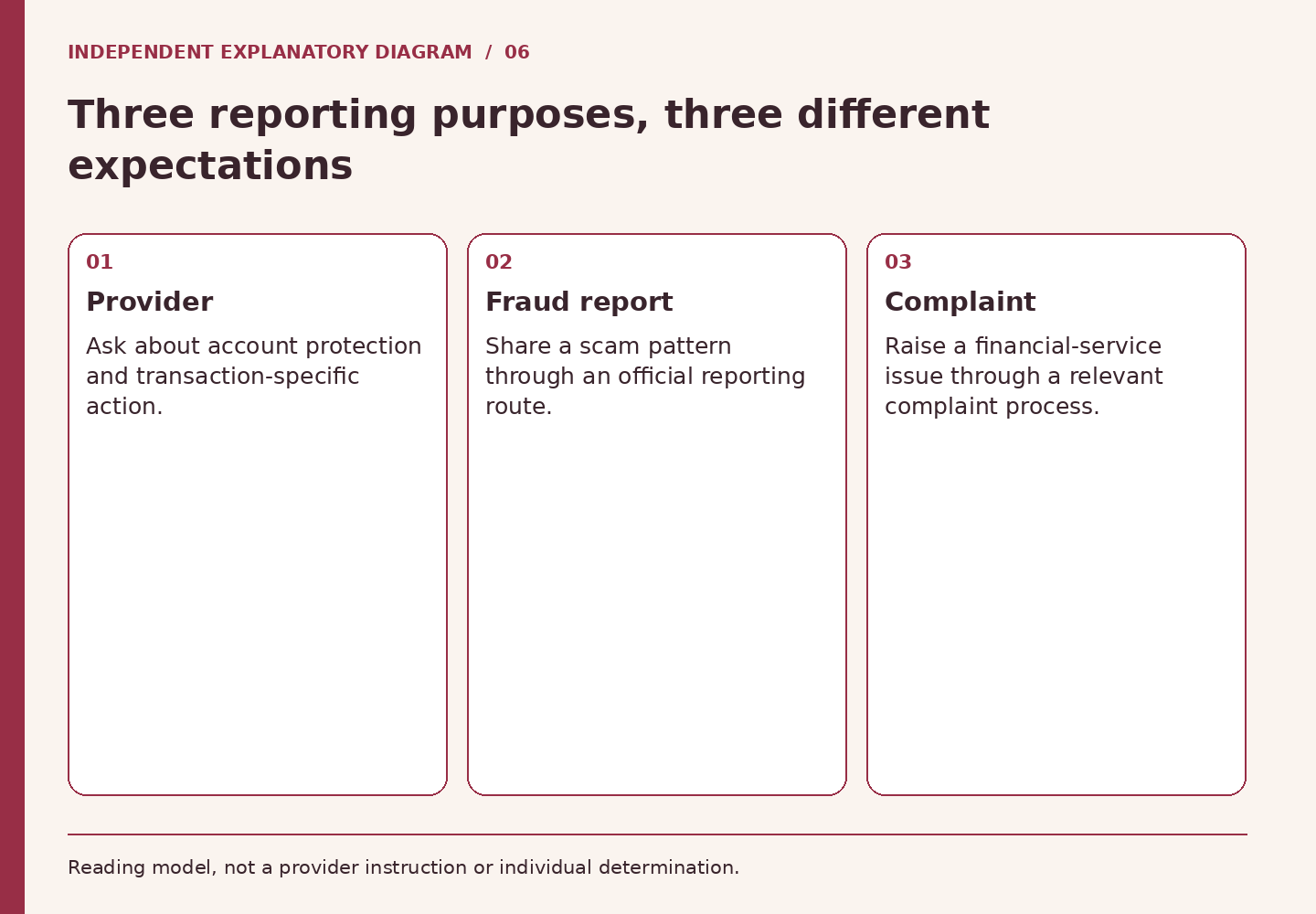
If a card, PIN, account access or transaction is at risk, contact the genuine provider promptly. The CFPB explains why prompt provider reporting matters for prepaid-card problems. Do not wait to complete a worksheet, publish a warning, obtain a police report, or submit an unrelated complaint before starting the applicable provider process.
Match the organization to the requested result
Ask yourself what you want the next contact to accomplish. “Protect access to my account” is different from “Tell an agency about an impersonation pattern.” “Raise an unresolved issue with a financial company” is different again. You may need more than one route, but each contact should have a clear purpose so a reference number from one does not become a false assurance about another.
The CFPB accepts complaints about prepaid cards and other financial products and describes how complaints are sent for response. This is not an emergency account-control service or a promise of reimbursement. The FTC provides recovery guidance and a route to report scams. Its general reporting role should not be mistaken for direct control over your card.
Keep the first account short and accurate
An original opening structure is: what happened, what you did, what you noticed afterward, and what help you need now. For example, in a fictional scenario: “An unexpected caller claimed to be support. I shared a code. I then received a notice I did not expect. I need to know how to protect my account.” This does not require knowing the caller’s actual identity.
State whether you initiated a payment under deception or whether someone else made a transaction without your permission. Do not choose a label because you think it will produce a better outcome. Ask the official recipient which information it needs and how to send it securely. Keep credentials and codes out of ordinary email and out of this publication.
Track confirmation without declaring the matter finished
After urgent contact, a private note can record the organization, date, reference if supplied, action confirmed and next instruction. Separate what was requested from what the recipient said it actually did. If instructions are unclear, ask a follow-up through the verified route. A report acknowledgment does not establish that a payment stopped, that a device is safe, or that a reimbursement is approved.
Follow any applicable provider or legal deadlines rather than a schedule suggested by this article. Procedures and protections depend on the event and program. If a new caller claims your report unlocked a guaranteed refund, independently verify the claim before disclosing anything. Continue with the second-scam warning. This publication is educational: its reading tool does not submit reports, notify a provider, calculate liability or preserve a filing deadline.
Sources and reading boundaries
Sources checked October 7, 2026. This is a review date, not a policy effective date or an account test.
- CFPB: Lost or stolen prepaid card, PIN or unauthorized charges: Prompt provider reporting; payroll cards have federal error-resolution protections. Particular liability, procedure and outcome are not determined here. Review basis: Official source text reviewed through search-index retrieval; direct navigation may be unavailable.
- CFPB: Submit a complaint: Current complaint scope includes prepaid cards; complaint routing is distinct from urgent account protection or a guaranteed remedy. Review basis: Official live page directly opened and reviewed.
- FTC: What To Do if You Were Scammed: Prompt payment-provider contact and recovery requests, account and identity recovery routes. No promise of reimbursement. Review basis: Official source text reviewed through search-index retrieval; direct navigation may be unavailable.