If you have already responded to a suspicious contact, you do not need to finish reading before seeking help. Contact the affected financial provider promptly if a card, PIN, credentials or money may be at risk. The CFPB specifically urges prompt reporting of a lost or stolen prepaid card or PIN and unauthorized charges. This article can help describe the situation afterward; it cannot protect or recover an account.
A common obstacle is thinking you must first decide whether the event officially counts as fraud. You can report a concern in ordinary language. “I gave information to someone I now believe was impersonating support” is useful even before you know the full consequences. Do not wait for a missing balance to confirm that access information matters.
Identify what changed
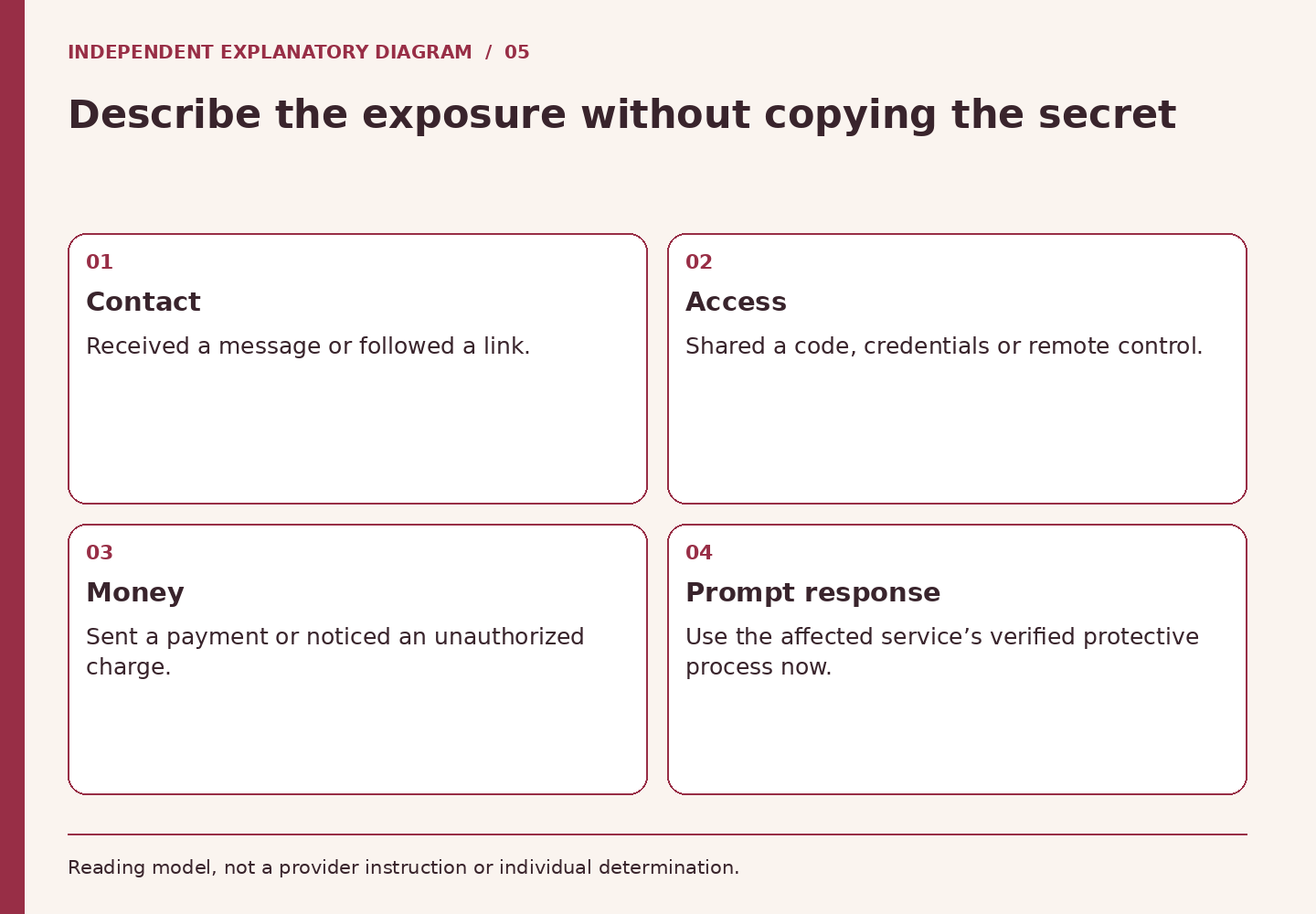
Think in categories rather than copying secrets into a worksheet. Did you only receive a message? Open a link? Download a file? Share a code or password? Grant screen access? Send money? Notice a transaction you did not initiate? Several categories may apply. A later action does not erase an earlier one, and a payment can coexist with a device or identity concern.
This categorization is an original communication aid, not a risk score. Receiving a message alone does not establish an account compromise. Sharing credentials is different from merely reading an alarming subject line. Be accurate about what you know and what remains uncertain, because the appropriate service may need different protective steps for each exposure.
Describe actions without rewriting them
In a fictional example, a worker reads a code to a caller and then sees an unexpected account notification. A useful description preserves that order. It does not change the story to “nothing happened” because no money is visibly missing. Another worker may have personally initiated a transfer after being deceived. That detail should also be stated honestly rather than relabeled to fit an expected reimbursement category.
If you cannot recall an exact time, say it is approximate. If you do not know whether a transfer completed, say what the screen or provider confirmed and what you have not checked. You can add information through the official process later. A careful correction is better than a confident guess that sends an investigation in the wrong direction.
Use the right recovery process
The FTC’s recovery guide separates payment, account, identity and device concerns. Follow the relevant service’s genuine instructions. Use a trusted device and route where needed, especially if remote access was granted. Do not send account documents or credentials to this publication; its editorial contact cannot take protective action.
Once immediate reports are underway, make a short private record of whom you reached, what was confirmed and what remains required. A reference number confirms an interaction, not that every problem is solved. Avoid treating a blocked phone number or changed password as proof that all exposure is resolved. Continue with reporting purposes and new recovery offers. The useful next step is a verified action matched to the actual exposure, without blame or a promised outcome.
Sources and reading boundaries
Sources checked October 7, 2026. This is a review date, not a policy effective date or an account test.
- CFPB: Lost or stolen prepaid card, PIN or unauthorized charges: Prompt provider reporting; payroll cards have federal error-resolution protections. Particular liability, procedure and outcome are not determined here. Review basis: Official source text reviewed through search-index retrieval; direct navigation may be unavailable.
- FTC: What To Do if You Were Scammed: Prompt payment-provider contact and recovery requests, account and identity recovery routes. No promise of reimbursement. Review basis: Official source text reviewed through search-index retrieval; direct navigation may be unavailable.