A caller says your paycard will stop working unless you follow instructions immediately. Before deciding whether every detail sounds believable, notice the shape of the conversation. Are you being told to stay on the line, keep a secret, ignore other people, or move money? Those demands are important information. You do not need to prove a crime before declining to continue an unexpected conversation.
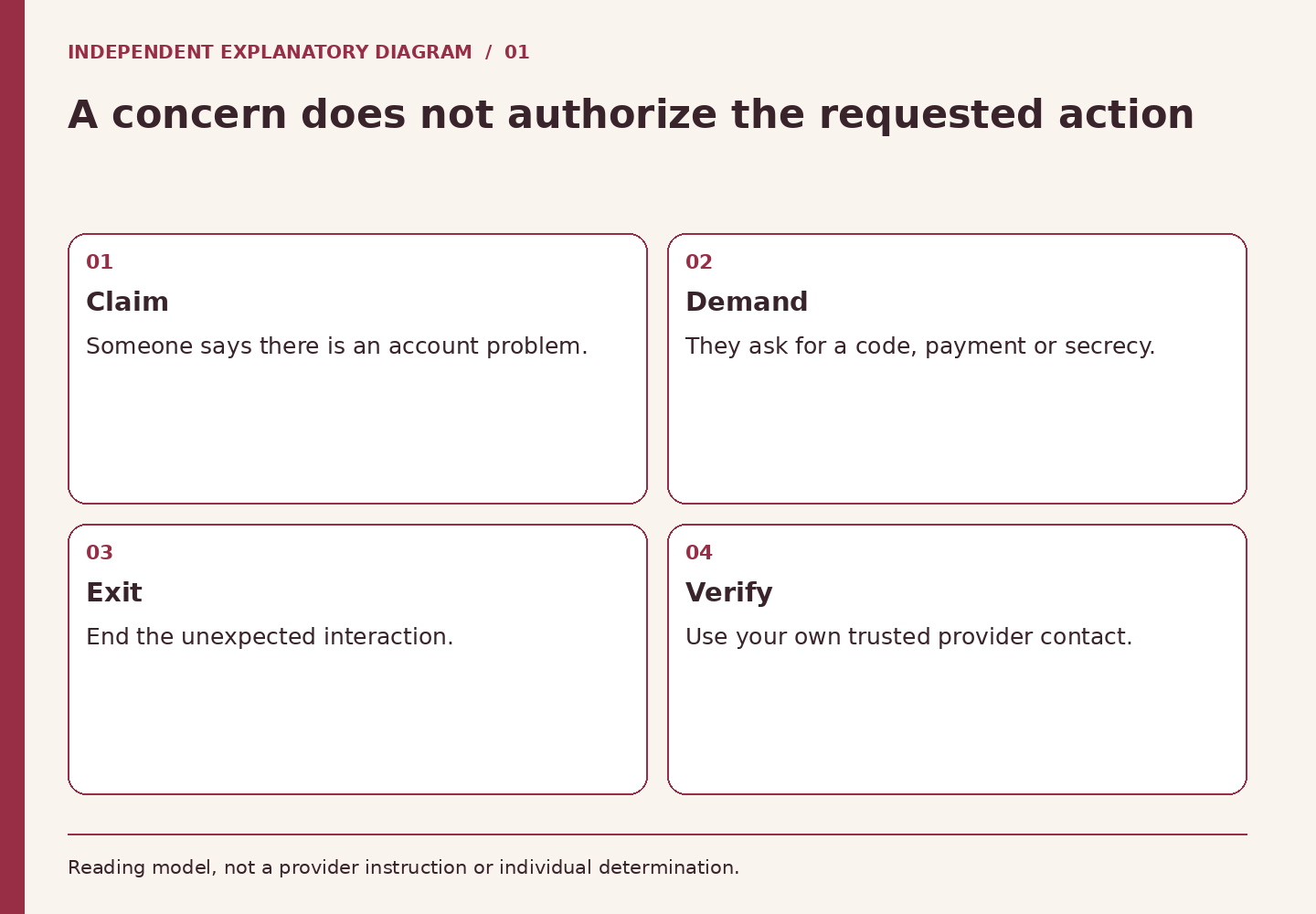
The FTC identifies impersonation, urgency and restrictive payment directions as recurring scam signs. This article turns that short warning into a practical pause exercise. It does not authenticate a message or say that every frustrating customer-service experience is fraud. If funds, a card, a PIN or account access may already be compromised, contact your verified provider promptly instead of completing this exercise first.
Separate the claim from the demanded action
Write two short sentences mentally or on paper. The claim might be, “There is unusual activity.” The demanded action might be, “Read a code to this caller.” A plausible first sentence does not make the second safe. You can take an account concern seriously without following the person who introduced it. This distinction is especially useful when the caller knows your name, employer or an old product name.
Fintwist is now identified as Corpay Prepaid on the provider’s public website. A scammer can copy either name. Treat correct branding as something a sender can learn, rather than a private test only the genuine provider could pass. The relevant question is whether you independently reached the responsible organization through a trusted route.
Use a stopping sentence you can remember
An original practice sentence is: “I will check this through my own contact information.” You do not owe the unexpected caller a debate, a warning that you are suspicious, or an explanation of where you will call. End the interaction. If you feel too overwhelmed to speak, ending the call or stopping replies is still a reasonable boundary. Do not click an offered verification link to demonstrate that you are cautious.
In a fictional example, a worker receives a call during a short break. The caller knows the employer’s name and insists the worker has sixty seconds to protect a payment. The useful observation is not whether the voice sounds professional. The caller has made ordinary verification seem dangerous. The worker’s next step is to leave that conversation and independently contact the relevant provider, with no payment or code disclosure in between.
Make the second conversation genuinely separate
Choose a number already on your card or current statement, or navigate independently to the provider’s verified official site. Do not accept a transfer from the suspicious caller as a fresh verification. A different voice in the same call can still belong to the same operation. Explain the concern in your own words to the independently reached service, and follow its current process.
For a rehearsal, use a made-up scenario and ask a willing friend to identify the pressure point. There is no need to reproduce a real threatening message or expose account details. A successful rehearsal ends with a clear stopping action, not a clever argument. Continue with requests for secrecy or what changes when something has already been shared.
Sources and reading boundaries
Sources checked October 7, 2026. This is a review date, not a policy effective date or an account test.
- FTC: How To Avoid a Scam: Common impersonation, pressure and payment-direction warning signs; independent verification and trusted-person support. Review basis: Official source text reviewed through search-index retrieval; direct navigation may be unavailable.
- Corpay Prepaid: public home page: Current Fintwist to Corpay Prepaid naming and PayCard/FlexCard distinction only. No generalization of issuer, fees, feature eligibility, or individual terms. Review basis: Official live page directly opened and reviewed.